
Hola familias y estudiantes. This site is where I (Srta. Hippe) will be posting videos, activities and supplemental material for students to help them study and complete assignments. Each Unit of Inquiry in the main classroom will be aligned with a focal point of study for the Spanish classroom as well. It is my hope that students and families take advantage of this page to gain competence and confidence in each of the sections we study. The sections will appear with the most recent, or current section first.
For students who do not show competence in a certain subject matter, this page will be invaluable. These students will have the opportunity to retest on the subject matter at their own pace. Each student will have areas in which they excel, and areas that require a little extra attention, needing extra time is not a problem! I will direct the student to the correct activities to practice and study, and when they feel ready, they will let me know and can be retested in an equivalent way. It is essential that we are mastering the subjects before too long, or the language can begin to feel overwhelming. Each new section is UPPERCASE, BOLDED AND UNDERLINED If your student is needing a little extra time with a subject, a note will be sent home so you can help review as well. Learning is more fun when we all participate!
KAHOOT AT HOME:
This is a really popular request from students. Kahoot is one of the game platforms we use to review and practice in class. Typically it is used in a classroom, the teacher projects a game pin on the board, and the students enter the pin, make a nickname, and the game begins. The question and options are on the board, and the student screen shows the symbols for them to pick. This can be done at home, individually, or by collaborating with peers. There are a few options for doing it at home. To be a game host, you need an account with Kahoot (only the host needs to be logged in). Once logged in, you pick your game. I post links on our blog, but there is the option to DISCOVER and search new games that are already made. If you are alone, you can have two windows open side by side (which I think is easiest), or in two tabs. To host a game: KAHOOT.COM and to join a game: KAHOOT.IT
-ER/-IR VERBS:
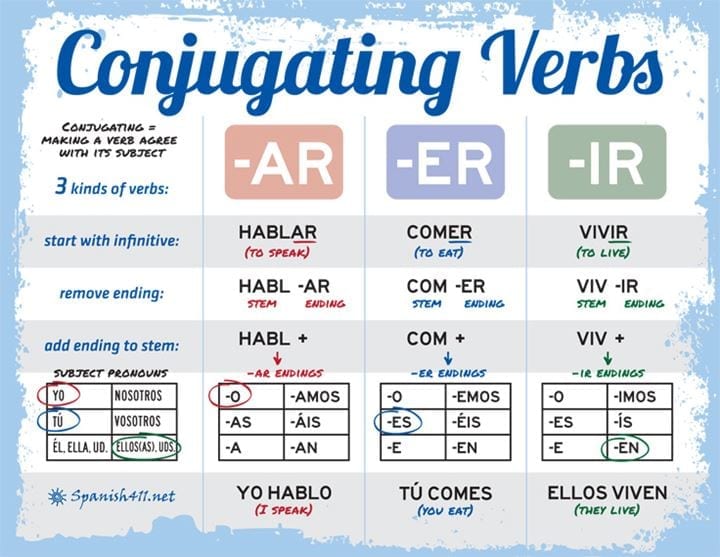
In Spanish there are three types of verbs, -AR/-ER/-IR. We already studied the -AR, and you all did ¡muy bien!, now it is time to learn the other two types. -ER/-IR verbs are almost the same, except for nosotros and vosotros. This chart shows the endings for all three types:
KAHOOT:
This Kahoot has AR/ER/IR verbs: Kahoot
This Kahoot has transaltions and conjugations: Kahoot
QUIZLET:
ADJETIVOS:
SER:
Spanish has two verbs that mean “to be”, ESTAR was the first verb we learned about (used for feelings and locations), and SER is the second one. We use to describe physical characteristics and personality. We can also use SER to say where someone is from, or what their job is.

NAVIDADES EN ESPAÑA:
We will be moving our cultural shift towards Spain for the month of December and part of January. Students will continue to practice with -AR verbs during this time. Students, be sure to continue to study your conjugations!
DÍA DE LOS MUERTOS:
Through this Second Unit of Inquiry, we will be matching our grammar studies with Día de los Muertos (Day of the Dead) cultural activities. The culminating activity of this section will require some help from home! The project information will be shared via your student when the time comes. We will have two sets of vocabulary, one set is common things related to Día de los Muertos, and the other is a list of verbs. Spanish has three types of verbs, -ar, -er and -ir. We will learn only about -ar verbs in this UI.
What is Día de los Muertos?
Música:
Verbos -AR
ESTAR

Vocabulary Día de los Muertos:
Verbs Día de los Muertos:
PRONOUNS
Gustar: to please (to like)
Gustar is a verb that does not have the exact same meaning in English and Spanish. In Spanish it means “to please”, and in English we say “to like”. This means that we conjugate (make different forms of verb) it a little differently. The thing we like in English is the subject in our sentence in Spanish.
Ejemplo: I like pizza=Me gusta la pizza (The pizza pleases me.)
I like pizzas=Me gustan las pizzas (The pizzas please me.)
Gusta is the form used for singular subjects or verbs.
Gustan is the form used for plural objects.
Me gusta(n)=I like…
Te gusta(n)= you (informal) like…
Le gusta(n)= you (formal)/he/she/it likes…
Nos gusta(n)= we like…
Os gusta(n)= you all (in Spain) like…
Les gusta(n)= you all (everywhere not in Spain)/they like…
Gustar videos:
Gustar practice:
Gustar story/quiz:
- A mí y mis amigos nos gustan muchas cosas diferentes. A Lou le gusta mucho explorar. Ella es muy curiosa. A Mariela y Juan, no les gusta cocinar, les gustan los restaurantes en Boise. Prefieren los restaurantes mexicanos. A mi mama, le gusta acampar en las montanas. A mi papa, le gusta pescar en los lagos. A mi, me gusta practicar yoga. Practico yoga todos los días. A Jennifer, no le gusta practicar yoga. Prefiere estudiar. Y a ti, ¿qué te gusta? ¿qué no te gusta?
Greetings and farewells:
SPANISH FOR TRAVEL
 Welcome to 4th Grade!